|
||||||||||||||||||||||||||||||||||||
Friday, March 6, 2015
SaraJaneBoyersPhoto_2015 Lunar New Year Greeting


Tuesday, February 17, 2015
Even before the 2015 Lunar New Year Eve....
I am embarrassed that I have not kept up my blog for the Finding Chinatown project is always on my mind and recently, when I re-organized my studio and purchased more flat files, I had the opportunity to review my exhibition pics that are so lovely and were the subject of such good reviews in my solo show at Craig Krull Gallery in Santa Monica, now four years ago.
I have been thinking about this show as the Walt Disney Family Museum's retrospective - WATER TO PAPER: PAINT TO SKY - on my friend Tyrus Wong, now 104, travels to New York's Museum of Chinese in America, to open to the public on 25 March. I will be there but best, so will Tyrus! It is more than time that he is honored not only in California but throughout the nation for his beautiful paintings, sketches, ceramics and of course, his handmade kites! It will be a good year.
On the eve of the Year of the Sheep/Ram/Goat, I realize that I made no post last year although again, I was out and about in the greater Los Angeles area photographing so many celebrants and temples not only on the eve but on the Saturday thereafter. On the eve, we toured with Eugene Moy and his wife Susan to wander, our second year of adventuring together, and it was wonderful. Eugene is the former chairman of the CHSSC (see below) and his knowledge is encyclopaedic but even he was in awe of the great diversity and wealth of presentations of the New Year celebration. We are all joining together for 2015 again!
Here, quickly is a sampling from those photographs. The locales vary from downtown's Chinese Historical Society of Southern California (CHSSC) where traditional flags were being readied to carry in the Chinatown parade, to temples in the San Gabriel Valley. Everywhere there was excitement about the new year, welcoming celebrants and of course, good food!
More to come after the festivities and traditional events for the Year of the Sheep start getting underway! Happy New Year!


I have been thinking about this show as the Walt Disney Family Museum's retrospective - WATER TO PAPER: PAINT TO SKY - on my friend Tyrus Wong, now 104, travels to New York's Museum of Chinese in America, to open to the public on 25 March. I will be there but best, so will Tyrus! It is more than time that he is honored not only in California but throughout the nation for his beautiful paintings, sketches, ceramics and of course, his handmade kites! It will be a good year.
On the eve of the Year of the Sheep/Ram/Goat, I realize that I made no post last year although again, I was out and about in the greater Los Angeles area photographing so many celebrants and temples not only on the eve but on the Saturday thereafter. On the eve, we toured with Eugene Moy and his wife Susan to wander, our second year of adventuring together, and it was wonderful. Eugene is the former chairman of the CHSSC (see below) and his knowledge is encyclopaedic but even he was in awe of the great diversity and wealth of presentations of the New Year celebration. We are all joining together for 2015 again!
Here, quickly is a sampling from those photographs. The locales vary from downtown's Chinese Historical Society of Southern California (CHSSC) where traditional flags were being readied to carry in the Chinatown parade, to temples in the San Gabriel Valley. Everywhere there was excitement about the new year, welcoming celebrants and of course, good food!
More to come after the festivities and traditional events for the Year of the Sheep start getting underway! Happy New Year!

Monday, February 25, 2013
The Year of the Black Water Snake 2013

HAPPY LUNAR NEW YEAR
GUNG HAY FAT CHOY
新年快乐
GUNG HAY FAT CHOY
新年快乐
For almost a decade now, my FINDING CHINATOWN project has included an annual visit to the greater Los Angeles Chinatowns to photograph the Chinese/Lunar New Year. Each year has deepened my understanding and appreciation of the diversity of the culture and tradition of the New Year, especially as it evolves in this American story.
This is the YEAR OF THE BLACK WATER SNAKE, a year within the traditional twelve sign zodiac, that carries both difficult characteristics combined though with a warmth and good sense of communication. It is a year of progress and attention to detail.

In Chinatown Plaza in downtown Los Angeles
On the eve of
the New Year, Saturday 9 February, I met up with Eugene & Susan Moy at the
Chinese Historical Society of Southern California (CHSSC). Eugene is
actively involved in the greater Los Angeles American Chinese community,
including his position as President Emeritus of the CHSSC and current Board
Member of the Chinese American Museum. Between his in depth historical
knowledge of the Chinese immigration throughout the United States and Susan's
visual eye - she has recently retired as an art instructor at Glendale
Community College - we were on our way to an emotional, educational and terrific
journey during which Eugene planned to traditionally honor his recently
deceased mother by lighting incense to her memory in as many places of worship
as possible on the New Year. And so he did and, so did we: eight temples
and associations starting in downtown Los Angeles to Lincoln Heights, Alhambra,
and El Monte and then back to LA.
It was an extraordinary adventure, not the least of it was the eight visits within 7 hours.
The first: the QUAN YUM TEMPLE on North Broadway contained traditional altars, a convent for Buddhist nuns, plus one of the few remaining funereal rooms of another day. Following the Tao/Dao tradition, a young reverand spoke about the offerings among the urns, the Master's writing tablets encased in a clear vitrine and the symbolism of the Kuan Yin with "1000 pieces." The story: that the buddhisattva tried so hard to do good that ultimately she was split into many pieces (the many arms of the golden statue) so she could finally accomplish all that she intended.It was an extraordinary adventure, not the least of it was the eight visits within 7 hours.
Next to the AMERICAN VIETNAM CHINESE FRIENDSHIP ASSOCIATION, also on North Broadway. Not a formal "temple" but an association, the AVCFA provides both places for worship as well as for community resources. Its very title speaks to the great diversity of ethnic Chinese in the Southen California area: 19th & 20th century immigrants from the Guangdon province, mid-century immigration from Taiwan and more recent immigration of ethnic chinese from Southern Asia. This was apparent from our conversation with the AVCFA's security guard: 72 years old and conversant in seven languages from French to Vietnamese, English and four chinese dialects, including Mandarin and Cantonese.

Imagery above from Quan Yum and more from the AVCFA (I also visited there last year). In the closet are the brooms ritually used to sweep out the evil spirts in preparation for the New Year. They are then literally "closeted" away for the first days of the year to keep the spirits from returning.
The mood changed as we departed downtown LA for the San Gabriel Valley and the next two temples: the Chong Hua Tong Moral Association in Alhambra and the World I-Kuan Tao Headquarters, the first of a number of temples that line El Monte's "Temple Row" on Lower Azusa Avenue. Both temples belong to more formal Tao orders and even though we were early - most people start to gather at the temples at nine or ten pm after family dinners - there was a pervasive atmosphere of quiet, mixed with ritual chanting and incense offerings.
CHONG HUA TONG MORAL ASSOCIATION is unassuming, located at the back of a parking lot. I had visited this temple for their Sunday meetings some years ago and carried away the impression of a serious meditative and literate tradition. We waited outside the sanctuary while a new member was inducted. When complete, the Master - a beautiful woman in white robes with a face that radiated goodness - spoke expressively to us in Mandarin, translated by a member there even for Eugene whose family dialect was Cantonese, about the Dao tradition and pointed out the shortened incense sticks and symbolic ash, representing Earth, to be used in the chanting ceremony, soon commenced when the Master and another woman serially lit incense sticks for each Buddha, bowing and engaging in ritual chant that varied, it seemed, only by name. In dramatic contrast to the other temples we visited, it was apparent that the New Year celebration here was not to be the typical crowded gathering but instead, a personal time of reflection and commitment.
We were again struck by the openness and willingness to welcome us and explain tradition, a characteristic not only of the New Year, but also in so many of the Chinatowns I had visited for FINDING CHINATOWN. Before we left, we were offered a ritual New Year's sweet, to start it off with something good and rich.
The quiet was also characteristic of the WORLD I-KUAN TAO HEADQUARTERS, located on "Temple Row," right next to another temple. Here youth prepared for a small midnight presentation while the vast and generally unadorned upstairs sanctuary was quiet with only the occasional individual lighting incense. At the Headquarters, the New Year starts not at midnight but at 11pm on the Eve, following an older Chinese tradition and partially as a result of the symbolic attachment of "bad" to even numbers and that fact that traditional Asian time calculation is broken into two hour periods rather than one. The offerings were also presented in groups of odd numbers, e.g., five rather than four (four is an especially malevolent number). They are also symbolic. For example, the sound of the name for apples is similar to that of "peace," and thus, apples are often brought as offerings.
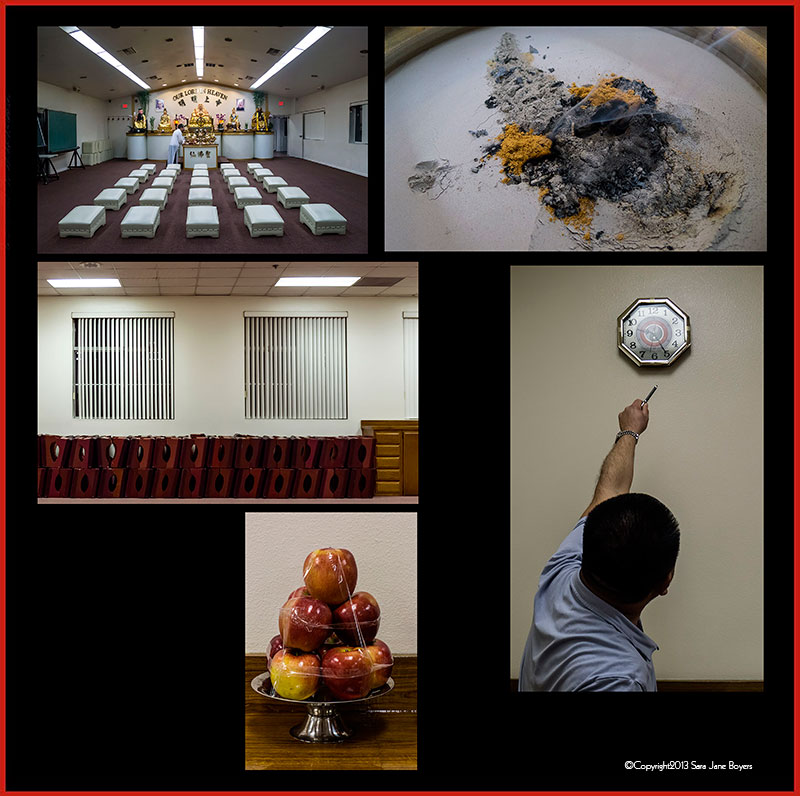
In the Dao tradition, congregants use prayer cushions, set up at the Chong Hua Tong Moral Association and at the "Headquarters,” lined up against the walls, waiting.
A return to exuberance for the remaining temples we visited on "Temple Row" that were open for the night. There were more, some not open that evening, and others, just too many to view as the midnight hour approached. The next two, respectively contiguous and opposite the World I-Kuan Tao Headquarters.Separated only by a wall from the Headquarters, WAKEN TEMPLE is stunning, its central space focused on an intense blue wall where shelves of Buddha’s and artful plants are precisely arranged. It is in the Mahayana Buddhist/Tibetan Buddhist tradition of the Bodhisattva Avalokiteśvara and the Prajna-Paramita Heart Sutra that states, "Form is empty (Śūnyatā). Emptiness is form," all leading to a search for the ultimate truth (ref: Wikipedia).
We shed our shoes at the doorway. The crowds were large but within was an overall sense of restraint. Many were seated on prayer cushions, quietly reading from the Sutra. Others were lighting beautiful votives. Others on the phone (it IS LA... ) Crowds were arriving in anticipation of the New Year.
QUAN AM BUDDHIST FELLOWSHIP is directly across from Waken Temple and the World I-Kuan Tao Headquarters. It was not at first apparent that this was a temple and we almost drove by it however as we noticed others visiting, we parked again. Thus we entered a former small house from the back driveway, the rooms saturated with the scent of flowers and overwhelming visual treats. Altars, tables and walls were filled with gold Buddha’s (including the red Buddha, the Laughing Buddha and many others that serve to protect the space and tradition), photographs, flower vases containing symbolic flowers (yellow chrysanthemums throughout), carpets on top of carpets. and monks and Master in attendance, greeting each who entered. The Fellowship appears to follow Vietnamese/Chinese cultural norms. A kitchen where the New Year's Day vegetarian meal was being prepared and a garden/nursery were behind.
All was presided over by the Master, educated extensively in both Eastern and Western tradition, the latter including a Masters in Divinity from Berkeley, who invited us to share tea with him. The Tea Ceremony was elaborate, beautiful and memorable, characterized by a ritual warming of the tea by pouring hot water over the teakettle repeatedly, accompanied again by sweet cakes for the holiday.

On El Monte's "Temple Row:" Waken Temple & the Quan Am Buddhist Fellowship
Midnight was fast approaching as we headed south on Lower Azusa Road in search of another temple and discovered PURELAND LOTUS COMMUNITY/PHUOC HUE WORSHIPING CENTER, another modern temple built in what is starting to seem to us a typical pattern: walled, parking lot in front (and on these very deep El Monte lots, also in back), two story with sanctuary and a community center, also in the back. At Pureland, the sanctuary is divided into three rooms, the foremost grand but the others equally resplendent with richly stained wooden altars covered with Buddhas and flowers The New Year's Day vegetarian soup was already being served in the back room.
We rushed from there for one last visit: the HAI NAM ASSOCIATION OF SOUTHERN CALIFORNIA. http://www.hainamusa.org As with the Chua Ba Thien Hau Temple in downtown Los Angeles, the Hai Nam Association is one to which I frequently return and, in fact, was until two years ago located opposite Thien Hau. The new temple replicates one in Hai Nam, China from which many of its attendees emigrated, via two generations in Vietnam.
We arrived only a few moments past midnight and while fireworks explode there on New Year's Day only, the lion dancers were finishing their first performance. The dancers introduced this night the "very first" electrified lion mask in California, eyes shining through the glittery glass.
Smoke from the incense managed to fill even the vast sanctuary and at back, the commmunity hall was filled with celebrants partaking in the clear soup and sweet cakes. I was recognized from previous visits and again so graciously welcomed. It is an honour to share this tradition here. Eugene and Susan also have friends here, especially the current president of the association. A perfect way for all of us to end an amazing evening.
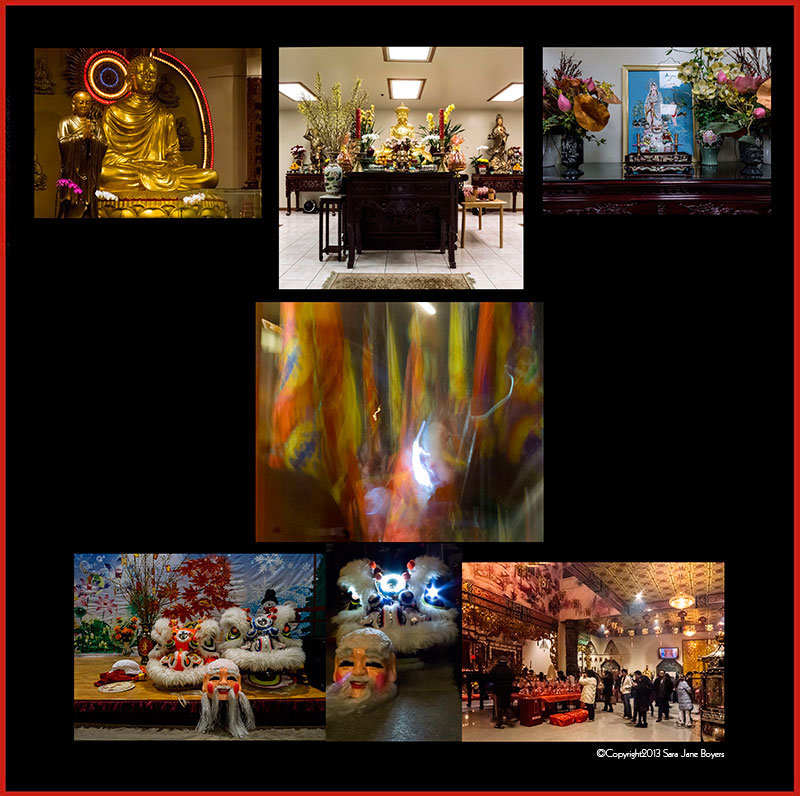
Floral at Pureland Lotus Community & Midnight at Hai Nam Association
We who live in Southern California are among the lucky ones for in the Chinatowns is yet another doorway into North America that remains open, providing a large and very diverse view into some of the identities, traditions and cultures that make up our nations, no matter how many generations before and after. Traveling around at the New Year's, especially this one, once again demonstates the strength of the fabric of the American Story that weaves together us all.
My thanks as always to the very many people who welcomed us into their celebrations, fed us and provided the grounding upon which this experience is based. My gratitude as well to Eugene and Susan Moy who so graciously shared all this with me.

I was additionally planning to use this New Year's Greeting as an update, long overdue, on my photographic activities. But this experience was so extensive and intensive and I have written more than planned and will leave a specific update for later.
Suffice to say that 2012 was wonderfully busy. Starting from my last New Year's Greeting in February 2012, I participated in six exhibitions including the FotoFreo Biennial in Australia and, in the first six months of the year, had photographs published in several magazines including Architectural Record. During the year my photographs garnered several awards, I commenced a serious investigation into architectural photography as a fine art, attended two well-received portfolio reviews (Palm Springs and the FotoFest Lens Culture/Paris reviews) and more!
In 2013, already my architectural fine art portfolio - REVISIT.RENEW.NEW - is growing and the early work can be seen on my website, http://www.sarajaneboyersphoto.com. In May, I am looking forward to an extensive visit to Detroit to resume and explore further for DETROIT DEFINITION and then in August, I am honored to be featured in a major retrospective of one of my favorite artists, 102 year-old TYRUS WONG, who continues to amaze and will be so honored by the Walt Disney Family Museum in San Francisco. I will be exhibiting there my photographic "story" of Tyrus and his hand-made kites.
More to come...
Gun Hay Fat Choy!
Sara Jane Boyers
sjboyers@sarajaneboyersphoto,com
www.sarajaneboyersphoto.com
www.sarajaneboyersisaloud.blogspot.com
www.findingchinatown.blogspot.com
www.detroitdefinition.blogspot.com
All images and text ©Copyright 2013 Sara Jane Boyers, All rights Resersved
Wednesday, November 28, 2012
TYRUS WONG: BRUSHSTROKES IN HOLLYWOOD
Good things happening for my friend, Tyrus Wong, a national treasure as an artist, animator and now at 102, the subject of a documentary by filmmaker, Pamela Tom, that is nearing completion.
TYRUS WONG: BRUSHSTROKES IN HOLLYWOOD follows Tyrus from his journey to the United States at age 7 with his father, through his young teen years as a scholarship student - they never knew how young he was! - at Otis Art Institute, through his both commercial and fine art career as an artist - the man responsible for the look of Disney's classic Bambi! Today he is the oldest living graduate of Otis.

I have been photographing Tyrus for several years now when he, in his fourth decade of retirement, brings his handmade kites to Santa Monica beach as a gift to us all.
Pamela has turned to Kickstarter to help fund the completion of BRUSHSTROKES IN HOLLYWOOD and I hope all of you will join in the campaign, TYRUS WONG: BRUSHSTROKES IN HOLLYWOOD at Kickstarter. Please support this documentary, aimed for completion by this coming summer. Kickstarter today just chose it as one of their own picks!!!! There are also some fun rewards for helping fund it, the funding increments in units of 8, a Chinese lucky number.
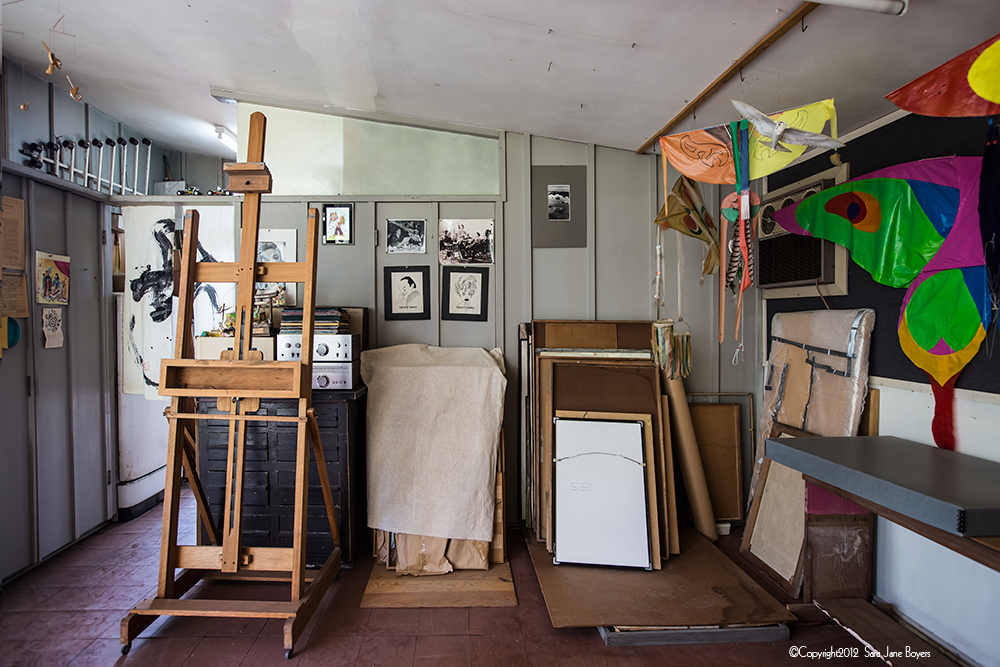
Recently I was privileged to be able to visit Tyrus' home/studio and here is a quick pic, along with one of my portraits of Tyrus and his kites, the portrait which I have happily contributed to the PR efforts for this film funding project.


TYRUS WONG: BRUSHSTROKES IN HOLLYWOOD follows Tyrus from his journey to the United States at age 7 with his father, through his young teen years as a scholarship student - they never knew how young he was! - at Otis Art Institute, through his both commercial and fine art career as an artist - the man responsible for the look of Disney's classic Bambi! Today he is the oldest living graduate of Otis.

I have been photographing Tyrus for several years now when he, in his fourth decade of retirement, brings his handmade kites to Santa Monica beach as a gift to us all.
Pamela has turned to Kickstarter to help fund the completion of BRUSHSTROKES IN HOLLYWOOD and I hope all of you will join in the campaign, TYRUS WONG: BRUSHSTROKES IN HOLLYWOOD at Kickstarter. Please support this documentary, aimed for completion by this coming summer. Kickstarter today just chose it as one of their own picks!!!! There are also some fun rewards for helping fund it, the funding increments in units of 8, a Chinese lucky number.
Recently I was privileged to be able to visit Tyrus' home/studio and here is a quick pic, along with one of my portraits of Tyrus and his kites, the portrait which I have happily contributed to the PR efforts for this film funding project.

Quiet for a while but updating again!
It was such a busy, terrific year that so much has happened but no time to update!
Five exhibitions from January until into the summer, some of it concerning the FINDING CHINATOWN project and others involved with my overall portfolio work. See my May post on my other blog, SARA JANE BOYERS ALOUD
Of course, the most wonderful was to have my images of the centarian artist (now 102) Tyrus Wong, and his kites - one framed composition and a flip-book - included in Sonia Mak's terrific Getty Pacific Standard Time (PST) exhibition and accompanying catalogue: 'ROUND THE CLOCK: CHINESE AMERICAN ARTISTS WORKING IN LA at the Vincent Price Art Museum at East Los Angeles City College http://latimesblogs.latimes.com/culturemonster/2012/03/pacific-standard-time-vincent-price-art-museum.html
The show was simply terrific and Tyrus' work - both his "commercial" animation and film design and his distinctive paintings - simply shone.


In Spring, again the Los Angeles Department of Cultural Affairs again requested and published several of my photographs of Los Angeles' downtown Chinatown in the Asian and Pacific Islander American Hertage Month Calendar & Cultural Guide.


Five exhibitions from January until into the summer, some of it concerning the FINDING CHINATOWN project and others involved with my overall portfolio work. See my May post on my other blog, SARA JANE BOYERS ALOUD
Of course, the most wonderful was to have my images of the centarian artist (now 102) Tyrus Wong, and his kites - one framed composition and a flip-book - included in Sonia Mak's terrific Getty Pacific Standard Time (PST) exhibition and accompanying catalogue: 'ROUND THE CLOCK: CHINESE AMERICAN ARTISTS WORKING IN LA at the Vincent Price Art Museum at East Los Angeles City College http://latimesblogs.latimes.com/culturemonster/2012/03/pacific-standard-time-vincent-price-art-museum.html
The show was simply terrific and Tyrus' work - both his "commercial" animation and film design and his distinctive paintings - simply shone.


And now, even better news for Tyrus. To come in following post!
In Spring, again the Los Angeles Department of Cultural Affairs again requested and published several of my photographs of Los Angeles' downtown Chinatown in the Asian and Pacific Islander American Hertage Month Calendar & Cultural Guide.

All the while, new themes from this extensive body of work - now over 12 years - present themselves to me and I look again at the project. Here: a light, no pun intended, but intriguing one: the color of the Chinatowns brought about so often by the choice of the lights for illumination used, in this case, fluorescence and the often naked blub:

Friday, February 10, 2012
The Year of the Water Dragon 2012

My Lunar New Year Greeting is online at http://us4.campaign-archive2.com/?u=013a28d9f024038bd399086bb&id=2e7d2cfa8f&e=9151fee9c4
With best wishes for a properous year.
Friday, January 20, 2012
Acquired by LACMA!

The Los Angeles County Museum of Art has just accepted Ming's Cafe (above), a print from FINDING CHINATOWN, into its collection. I am very honored.
Ming's Cafe, was taken from my trip through California's Central Valley in the inland city of Bakersfield.
I loved the trip for it crossed history and explained a lot about the migration of not only Asian (primarily Chinese and Japanese) immigrants to the United States in the late 1800s/early 1900s but also a terrific examplar of how American absorbs immigrants. I have posted previously about this in my post on Fresno.
In Bakersfield, a city where Chinese immigrants first came for agriculture, a large freeway exit points to Ming's Boulevard, one very prominent family. The early Chinatown was large. Today, with the generations of early Cantonese families gone and, in an area subject to earthquakes, one of which decimated the city and the Chinatown with it, there are remnants but also a burgeoning new "Chinatown," not centered as before but replete with newer immigrants from the Mainland and Taiwan.
So it was, in driving around Bakersfield's older center, that I saw construction close to this
"old-school" Chinese restaurant, Ming's Cafe. Plans are expansion and modernization however the interiors now, red "leather" booths and traditional ornament remind me of the Chinese restaurants of my youth.
 I ventured in, way before the lunch hour, where I met Wendy and her husband, recent immigrants from Hong Kong who had purchased the restaurant and were in the midst of renovation. Still open for business with older patrons in for their morning cup of coffee or tea, they were also preparing for their son's applications for law school.

Change continues in the Americas as each new person who arrives settles into our routines, not forgetting the old but adapting, joining and contributing their history and culture, their entrepreneurship, their expertise and best of all their intelligence and work ethics to our continual melting pot.
UPDATE
Sadly change does affect some of our historic places, as evidenced by another Chinatown I photographed on this same trip: that of the community of Hanford, further up. There a small group of preservationists are working hard to save the historic buildings and small museum. It is authentic, accurate and so worth saving. http://abcnews.go.com/Travel/wireStory?id=13867051#.TxnjTCMih1w
Subscribe to:
Posts (Atom)